
Planning a Tour du Mont Blanc itinerary is one of the most important parts of preparing for this incredible alpine adventure. While the traditional route takes approximately 10–11 days to complete, there are countless ways to customize your trek depending on your fitness level, available time, accommodation preferences, and the type of experience you’re looking for.
Some hikers prefer to take their time, enjoying leisurely days on the trail and spending extra nights in mountain villages. Others want to complete the entire circuit in a week or less, combining longer hiking days with strategically chosen accommodation stops and public transportation.
The good news? There’s no single correct way to hike the Tour du Mont Blanc.
We’ve put together nine detailed TMB itineraries ranging from four to twelve days, complete with daily distances, elevation profiles, suggested overnight stops, and our recommendations for making each route work. Whether you’re an experienced fastpacker or planning your first multi-day alpine trek, you’ll find a starting point for building your perfect itinerary.
Looking for a completely customized route? Our TMB Trek Planner allows you to build your own itinerary, compare different route options, incorporate public transportation, and check accommodation availability across the entire circuit.
The TMB Trek Planner brings your route, accommodation availability, and itinerary together in one place so you can plan with confidence.
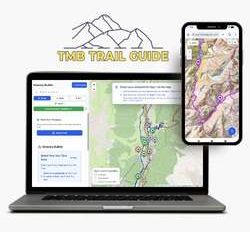
Build & plan a route that works for you!
See accommodation availability in one place
Adjust your itinerary as plans change
Designed around real TMB hut booking and itinerary challenges
How Many Days Do You Need to Hike the Tour du Mont Blanc?
Most hikers should plan on spending between 10 and 12 days hiking the Tour du Mont Blanc. This provides enough time to enjoy the incredible scenery, tackle the major mountain passes without rushing, and arrive at your accommodation each afternoon with time to relax.
However, the ideal itinerary depends on your hiking experience, physical fitness, and how much time you have available.
Here’s a general breakdown of what to expect:
4–6 Days: Trail Running and Fastpacking
Completing the entire TMB in four to six days is an ambitious undertaking that requires excellent fitness, previous experience with long-distance mountain hiking, and the ability to spend extended hours on the trail.
Expect several days of 25–40+ kilometers, significant elevation gain, and limited time for sightseeing. These itineraries are best suited to experienced trail runners and fastpackers.
7–9 Days: Experienced and Fit Hikers
A seven-to-nine-day itinerary is a good option for hikers who want to complete the entire circuit within a shorter timeframe.
You’ll still encounter some long days, often involving 20–30 kilometers of hiking and substantial elevation changes. However, with careful planning, it’s possible to complete these itineraries without running.
These routes are particularly appealing to experienced hikers who are comfortable spending most of the day on the trail.
10–11 Days: The Classic Tour du Mont Blanc
For most hikers, this is the sweet spot.
A 10- or 11-day itinerary provides a good balance between daily hiking distances, elevation gain, and time to enjoy the experience. You’ll have opportunities to stop in some of the most spectacular locations along the route, including Courmayeur, Rifugio Bonatti, and Champex.
This is also the most traditional way to experience the TMB, although accommodation availability can sometimes make the standard overnight stops difficult to arrange.
12–14+ Days: A More Relaxed Experience
If you have additional time, consider spreading the trek over 12–14 days or longer.
This allows you to break up some of the more challenging stages, enjoy extra nights in mountain villages, and incorporate rest days or alternative routes.
It’s also an excellent option for hikers who prefer shorter daily distances or want to spend additional time exploring the towns and villages along the route.
Our recommendation: Unless you’re an experienced fastpacker or have a particularly tight schedule, we’d recommend planning for at least 10 days on the trail. An 11- or 12-day itinerary is even better if you want to enjoy the experience without constantly watching the clock.
Can You Hike the Tour du Mont Blanc in Fewer Days?
Absolutely! While the traditional Tour du Mont Blanc takes approximately 10–11 days, experienced hikers can complete the circuit in considerably less time.
Seven- and eight-day itineraries are particularly popular among fit hikers who want to experience the entire circuit but have limited vacation time. These itineraries generally involve combining traditional stages, choosing alternative overnight stops, and occasionally using public transportation to shorten less interesting sections.
If you’re considering a shorter itinerary, there are a few things to keep in mind:
- Daily distances: Combining traditional stages can result in days of 25–30 kilometers or more.
- Elevation gain: Don’t focus exclusively on distance. A 20-kilometer day with 1,500 meters of climbing can be considerably more demanding than a longer, relatively flat stage.
- Accommodation: Shorter itineraries often require staying at less conventional locations, which can actually make accommodation bookings easier.
- Transportation: Strategic use of buses and cable cars can help reduce hiking distances while still allowing you to experience the highlights of the route.
We generally wouldn’t recommend trying to squeeze the entire TMB into fewer than seven days unless you’re an experienced trail runner or fastpacker. At that point, the trek becomes much more of an endurance challenge than a traditional hut-to-hut hiking experience.
4-Day Tour du Mont Blanc Itinerary
Average distance per day: 42.5 km
Average hours hiking per day: 12+
Longest stage: 46 km
Best for: Trail runners
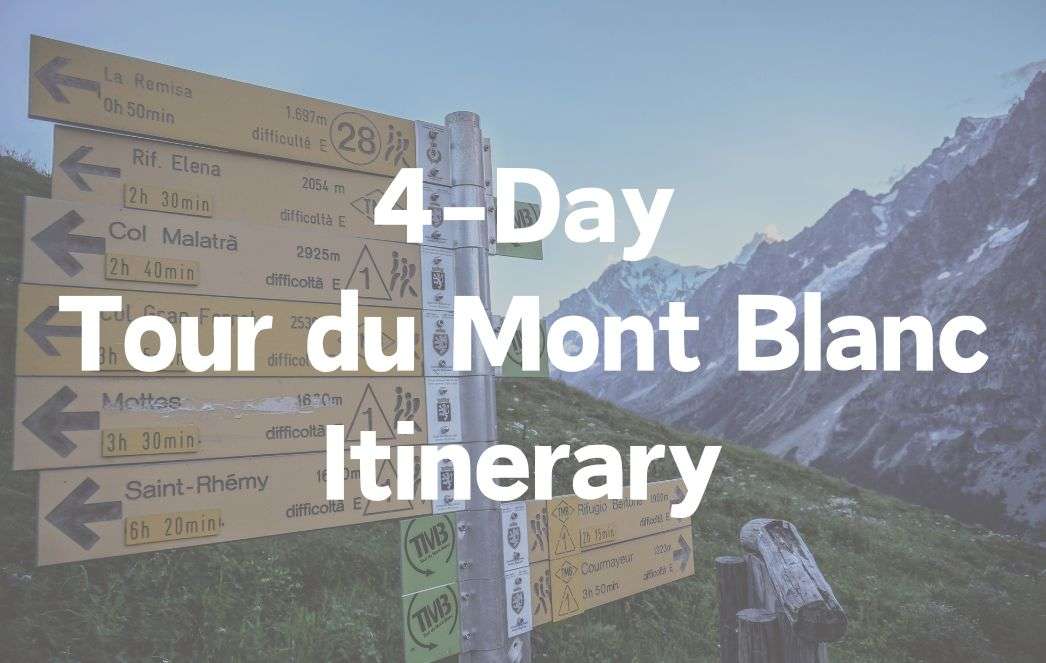
Reserved for only the most experienced trail runners and fastpackers, a four day Tour du Mont Blanc itinerary makes for an incredible challenge. Be prepared to spend 12+ hours on your feet and traverse multiple mountain passes each day.
If you have the willingness and skills to take on this type of Tour du Mont Blanc experience, you’ll find plenty of different ways to split the route across four days. You can also use public transport and/or cable cars in some strategic locations to help reduce some distance, although the purists amongst us may insist upon covering every step of the trail!
Our preferred itinerary begins by getting some of the most difficult terrain behind you on the first stage, then tackling longer but less challenging stages the following two days. You’ll finish your TMB circuit with a spectacular beast of a final stage that will be both stunningly beautiful and also incredibly challenging.
This itinerary is not for the faint of heart!
| Stage | Start | Finish | Distance (km) | Elevation Gain (m) | Elevation Loss (m) |
| 1 | Les Houches | Refuge des Mottets | 42.8 | 2760 | 1932 |
| 2 | Refuge des Mottets | Chalet Val Ferret | 43.3 | 2472 | 2557 |
| 3 | Chalet Val Ferret | Trient | 46.3 | 2303 | 2737 |
| 4 | Trient | Les Houches | 37.5 | 2664 | 2973 |
5-Day Tour du Mont Blanc Itinerary
Average distance per day: 34 km
Average hours hiking per day: 12+
Longest stage: 38 km
Best for: Trail runners

Completing the entire Tour du Mont Blanc in just five days is a very difficult undertaking, but you’ll find plenty of trail runners and even a few fastpackers who tackle it each season. Although this itinerary only adds a single day to the four day itinerary above, you’ll find that the stages end in larger towns, making accommodation and resupply quite a bit easier.
As with all of the trail running/fastpacking itineraries we’ve provided, the use of public transport will make the endeavor much more manageable. There are great public transit options on Stages 1, 2 and 4 that will allow you to still see the most incredible parts of the trail while also shortening those stages by quite a bit. Keep in mind that most buses and lifts only run during the peak hiking season.
The 5-day TMB itinerary is bookended with the most difficult stages, with the three middle stages being much more balanced in terms of distance and elevation gain. The final stage is a big one, but you wouldn’t want to finish such an ambitious TMB trek any other way!
| Stage | Start | Finish | Distance (km) | Elevation Gain (m) | Elevation Loss (m) |
| 1 | Les Houches | Les Chapieux | 36.5 | 2398 | 1883 |
| 2 | Les Chapieux | Courmayeur | 31.8 | 1616 | 1959 |
| 3 | Courmayeur | La Fouly | 32.9 | 2053 | 1646 |
| 4 | La Fouly | Trient | 31.2 | 1468 | 1738 |
| 5 | Trient | Les Houches | 37.5 | 2664 | 2973 |
6-Day Tour du Mont Blanc Itinerary
Average distance per day: 28 km
Average hours hiking per day: 12+
Longest stage: 36 km
Best for: Trail runners and fastpackers

Six days is roughly the transition point where it’s possible to hike the TMB circuit without any trail running. However, fastpackers completing the route in just six days will be in for a challenge and trail runners will still enjoy this pace. In fact, the six, seven, and eight day itineraries are the ones we recommended most often to runners.
Stage 2 tends to be the most difficult, with the crossing of three cols (Col du Bonhomme, Col de la Croix du Bonhomme, and Col de la Seigne) packed into a big 30 km day. You can shorten the distance a bit by taking the Col des Fours variant, although that will increase the elevation gain and overall challenge of the stage.
While Stage 4 is the longest in terms of distance, the trail is easy and has good bus services on the segment between La Fouly and Champex.
If you are very time constrained and feel confident in your ability to hike 12+ hours per day, the six day itinerary is a good option to consider.
| Stage | Start | Finish | Distance (km) | Elevation Gain (m) | Elevation Loss (m) |
| 1 | Les Houches | Refuge de la Balme | 25.4 | 1608 | 941 |
| 2 | Refuge de la Balme | Cabane du Combal | 29.7 | 1890 | 1616 |
| 3 | Cabane du Combal | Rifugio Bonatti | 25.7 | 1610 | 1558 |
| 4 | Rifugio Bonatti | Champex | 35.7 | 1551 | 2097 |
| 5 | Champex | Tre-le-Champ | 28.8 | 1971 | 2014 |
| 6 | Tre-le-Champ | Les Houches | 24.6 | 1569 | 1973 |
7-Day Tour du Mont Blanc Itinerary
Average distance per day: 24 km
Average hours hiking per day: 10 – 12
Longest stage: 29 km
Best for: Fastpackers
Circumnavigating Mont Blanc in seven days is quite an accomplishment. This itinerary is our go-to recommendation for fastpackers who prefer to cover as much ground as possible each day while still having enough time to enjoy the route. Most hikers should plan on hiking an average of 10 – 12 hours per day, but you’ll have several days that should require less time on your feet.
The 7-day itinerary also has more options in terms of accommodation if you can’t get a booking at the places we’ve outlined below. By splitting the route across more stages you’ll have a bit more flexibility. Public transit can be used to make this itinerary more accessible for those who don’t consider themselves fastpackers and are willing to skip a few sections of the trail.
Be warned that the second half of this itinerary can be quite difficult, with a few long stages that have significant elevation gain!
| Stage | Start | Finish | Distance (km) | Elevation Gain (m) | Elevation Loss (m) |
| 1 | Les Houches | Refuge Nant Borrant | 22.8 | 1353 | 938 |
| 2 | Refuge Nant Borrant | Refuge des Mottets | 20 | 1407 | 994 |
| 3 | Refuge des Mottets | Courmayeur | 25.5 | 1254 | 1910 |
| 4 | Courmayeur | Rifugio Elena | 20.3 | 1512 | 660 |
| 5 | Rifugio Elena | Champex | 27.9 | 1133 | 1710 |
| 6 | Champex | Tre-le-Champ | 28.8 | 1971 | 2014 |
| 7 | Tre-le-Champ | Les Houches | 24.6 | 1569 | 1973 |
8-Day Tour du Mont Blanc Itinerary
Average distance per day: 21 km
Average hours hiking per day: 10+
Longest stage: 30 km
Best for: Fastpackers and experienced hikers
An 8-day Tour du Mont Blanc itinerary enters the realm of what we would consider reasonable for the average hiker. Yes, you’ll need to plan on hiking for 10+ hours each day, but you won’t have to double up every stage.
You’ll notice that there is still a 30-km day included in our suggested itinerary below. However, it combines a portion of the easiest section of the TMB (between La Fouly and Champex) with a climb over the Grand Col Ferret and is easily shortened by using the reliable bus service between La Fouly and Champex.
Other notable stages on our 8-day TMB itinerary include Stage 6, which finishes at the top of the Col de Balme (and thus has a steep climb to finish the day), as well as Stage 4 which begins with a difficult descent into Courmayeur before a steep climb back up out of town.
| Stage | Start | Finish | Distance (km) | Elevation Gain (m) | Elevation Loss (m) |
| 1 | Les Houches | Refuge Nant Borrant | 22.8 | 1353 | 938 |
| 2 | Refuge Nant Borrant | Refuge des Mottets | 20 | 1407 | 994 |
| 3 | Refuge des Mottets | Rifugio Maison Vieille | 19.7 | 1223 | 1127 |
| 4 | Rifugio Maison Vieille | Chalet Val Ferret | 23.6 | 1249 | 1430 |
| 5 | Chalet Val Ferret | Champex | 30.4 | 1427 | 1723 |
| 6 | Champex | Col de Balme | 20.9 | 1753 | 1014 |
| 7 | Col de Balme | Refuge La Flegere | 14.9 | 1001 | 1324 |
| 8 | Refuge La Flegere | Les Houches | 17.6 | 786 | 1649 |
9-Day Tour du Mont Blanc Itinerary
Average distance per day: 19 km
Average hours hiking per day: 8 – 10
Longest stage: 23 km
Best for: Experienced hikers and those looking to challenge themselves

The 9-day Tour du Mont Blanc itinerary is one of our personal favorites! It combines some longer days with several of the traditional TMB stages and provides opportunities to spend the night in some unique refuges. Refuges Nant Borrant, Maison Vieille and Col de Balme are all lovely refuges that don’t see the same number of bookings as some of the more popular stopping points, making itinerary planning easier.
Pay attention to the elevation gain on Stage 7, and prepare yourself for the strenuous climb to the Col de Balme at the end of the day on tired legs. Beyond Stage 7, the remainder of the itinerary is fairly straightforward, just with a bit more distance and elevation gain than what you would see on a standard 11-day itinerary.
The 9-day route also has tons of flexibility in terms of stopping points, so if the options described below are fully booked, you can typically find a suitable alternative that won’t cause too many logistical issues.
| Stage | Start | Finish | Distance (km) | Elevation Gain (m) | Elevation Loss (m) |
| 1 | Les Houches | Refuge Nant Borrant | 22.8 | 1353 | 938 |
| 2 | Refuge Nant Borrant | Refuge des Mottets | 20 | 1407 | 994 |
| 3 | Refuge des Mottets | Rifugio Maison Vieille | 19.7 | 1223 | 1127 |
| 4 | Rifugio Maison Vieille | Rifugio Bonatti | 18.3 | 1125 | 1056 |
| 5 | Rifugio Bonatti | La Fouly | 20.4 | 959 | 1373 |
| 6 | La Fouly | Champex | 15.3 | 592 | 724 |
| 7 | Champex | Col de Balme | 20.9 | 1753 | 1014 |
| 8 | Col de Balme | Refuge La Flegere | 14.9 | 1001 | 1324 |
| 9 | Refuge La Flegere | Les Houches | 17.6 | 786 | 1649 |
10-Day Tour du Mont Blanc Itinerary
Average distance per day: 17 km
Average hours hiking per day: 7 – 8
Longest stage: 22 km
Best for: Average hikers who don’t mind a few longer stages.
The 10-day Tour du Mont Blanc itinerary maintains most of the “traditional” 11-day plan, albeit with a few key differences. Your first few days will mirror that of most 11-day hikers, but from there you will stretch some stages a bit longer in order to complete the circuit faster.
The most significant of these longer days is Stage 4, which has you bypass spending the night in Courmayeur, instead pushing further to Rifugio Bertone. Of course, it’s also possible to spend the night in Courmayeur, you’ll just need to make up the distance elsewhere.
The longer stages of the 10-day itinerary fall between the Italian and Swiss Val Ferrets, with the route crossing the Grand Col Ferret on Stage 5 to allow you to spend the night at the remote and lovely Alpage de la Peule. From here, you’ll extend Stage 6 all the way to Champex, which should be manageable for most hikers given this section of the TMB is considered the easiest of the entire route.
From there, the route mirrors the standard 11-day route from Champex all the way back to the start in Les Houches.
| Stage | Start | Finish | Distance (km) | Elevation Gain (m) | Elevation Loss (m) |
| 1 | Les Houches | Les Contamines | 17.2 | 1019 | 900 |
| 2 | Les Contamines | Les Chapieux | 19.3 | 1379 | 983 |
| 3 | Les Chapieux | Cabane du Combal | 18.6 | 1100 | 674 |
| 4 | Cabane du Combal | Rifugio Bertone | 17.8 | 1287 | 1285 |
| 5 | Rifugio Bertone | Alpage de la Peule | 21.8 | 1228 | 1123 |
| 6 | Alpage de la Peule | Champex | 21.8 | 646 | 1247 |
| 7 | Champex | Trient | 15.9 | 876 | 1014 |
| 8 | Trient | Tre-le-Champ | 12.9 | 1095 | 1000 |
| 9 | Tre-le-Champ | Refuge La Flegere | 7 | 783 | 324 |
| 10 | Refuge La Flegere | Les Houches | 17.6 | 786 | 1649 |
11-Day Tour du Mont Blanc Itinerary
Average distance per day: 15.5 km
Average hours hiking per day: 6 – 8
Longest stage: 20.5 km
Best for: The majority of TMB hikers
The 11-day Tour du Mont Blanc itinerary is a classic for a reason! The stages are well balanced and you’ll get to spend the night at some of the most spectacular locations along the route. However, you’ll also find that the typical accommodation stops on the 11-day route book up early. That said, you can almost always piece together a great itinerary at the last minute, especially if you are willing to use a bit of public transport and have some flexibility.
Although Stage 6 is the longest in terms of distance, we feel that the stage from Les Contamines to Les Chapieux is the most challenging. Not only does it come early in your hike, but it also has the most elevation gain and two (frequently snow-covered) cols that you’ll need to cross.
If you have the time, we highly recommend spending an extra night in Courmayeur or Champex!
| Stage | Start | Finish | Distance (km) | Elevation Gain (m) | Elevation Loss (m) |
| 1 | Les Houches | Les Contamines | 17.2 | 1019 | 900 |
| 2 | Les Contamines | Les Chapieux | 19.3 | 1379 | 983 |
| 3 | Les Chapieux | Rifugio Elisabetta | 14.5 | 1058 | 411 |
| 4 | Rifugio Elisabetta | Courmayeur | 17.3 | 558 | 1548 |
| 5 | Courmayeur | Rifugio Bonatti | 12.5 | 1094 | 273 |
| 6 | Rifugio Bonatti | La Fouly | 20.4 | 959 | 1373 |
| 7 | La Fouly | Champex | 15.3 | 592 | 724 |
| 8 | Champex | Trient | 15.9 | 876 | 1014 |
| 9 | Trient | Tre-le-Champ | 12.9 | 1095 | 1000 |
| 10 | Tre-le-Champ | Refuge La Flegere | 7 | 783 | 324 |
| 11 | Refuge La Flegere | Les Houches | 17.6 | 786 | 1649 |
12-Day Tour du Mont Blanc Itinerary
Average distance per day: 14 km
Average hours hiking per day: 6 – 8
Longest stage: 20.5 km
Best for: Hikers with extra time to savor their experience.
The 12-day itinerary works well for those who want to take their time on the trail and shorten the first few stages of the TMB, which are often some of the hardest. You’ll begin this itinerary with a very manageable hike to Refuge du Fioux, near the top of the Col de Voza.
From here, you’ll split what is typically one difficult stage to Les Chapieux across two days with a stop at the lovely Refuge Nant Borrant or Refuge de la Balme. This makes for a much easier crossing of the Col du Bonhomme and Col de la Croix du Bonhomme on Stage 3.
Upon leaving Les Chapieux, the route follows the standard 11-day itinerary, although there are countless ways to split up the remaining stages should you desire.
| Stage | Start | Finish | Distance (km) | Elevation Gain (m) | Elevation Loss (m) |
| 1 | Les Houches | Refuge du Fioux | 6.9 | 681 | 171 |
| 2 | Refuge du Fioux | Refuge Nant Borrant | 15.9 | 672 | 767 |
| 3 | Refuge Nant Borrant | Les Chapieux | 13.7 | 1045 | 945 |
| 4 | Les Chapieux | Rifugio Elisabetta | 14.5 | 1058 | 411 |
| 5 | Rifugio Elisabetta | Courmayeur | 17.3 | 558 | 1548 |
| 6 | Courmayeur | Rifugio Bonatti | 12.5 | 1094 | 273 |
| 7 | Rifugio Bonatti | La Fouly | 20.4 | 959 | 1373 |
| 8 | La Fouly | Champex | 15.3 | 592 | 724 |
| 9 | Champex | Trient | 15.9 | 876 | 1014 |
| 10 | Trient | Tre-le-Champ | 12.9 | 1095 | 1000 |
| 11 | Tre-le-Champ | Refuge la Flegere | 7 | 783 | 324 |
| 12 | Refuge la Flegere | Les Houches | 17.6 | 786 | 1649 |
Can You Hike the Tour du Mont Blanc in More Than 12 Days?
Of course! Although most published TMB itineraries range from 7 to 12 days, there’s no reason you can’t take two weeks or longer to complete the circuit.
In fact, a longer itinerary can be a fantastic way to experience the region, particularly if you enjoy spending time in mountain villages or want to incorporate some of the spectacular alternative routes.
Consider adding extra nights in:
- Courmayeur, Italy: One of our favorite towns along the route, with excellent restaurants, shops, and opportunities to explore the surrounding mountains.
- Champex, Switzerland: A beautiful lakeside village that’s perfect for a rest day.
- Chamonix, France: While technically near the end of the circuit, Chamonix is worth spending additional time exploring.
- Les Contamines, France: A lovely alpine village with access to additional hiking opportunities.
You can also use additional days to explore alternative routes such as the Fenêtre d’Arpette, Col des Fours, or Col de Tricot.
The beauty of the TMB is that you’re not required to follow a predetermined itinerary. If you have the time, we highly recommend slowing down and enjoying everything the region has to offer.
Custom Itineraries & More!
The itineraries described above are just a few of the endless ways to trek the TMB.
We work with dozens of TMB hikers each year who are looking for a more individualized itinerary to suit their specific needs. We are happy to help! We’ve created custom itineraries for those who want to utilize public transport, hike as many variants as possible, trek with their dog, hike with children, only stay in private rooms and/or hotels, plan a last-minute adventure, and many, many more special requests.
Below you’ll find descriptions of some of the custom TMB itineraries we help to create so you can get a sense of the possibilities. We would love to connect with you to discuss how we can help make your dream TMB adventure a reality.
Get in touch below!
Public Transport Supported
Use the many public transport options along the TMB to make the route more manageable.
Do the itineraries above feel intimidating? Are you concerned about the distance and elevation demands of the trek? Fear not!
While the TMB can seem intimidating, it is accessible for a variety of experience and ability levels. Utilizing public transportation can make the route much more approachable with shorter days and less climbing/descending.
TMB Variants & Alternates
Looking for more of a challenge and want to get off the beaten track?
If you’re the type who enjoys an extra challenge and wants to see some of the most spectacular views in the region, consider taking some of the alternate routes on the TMB.
Not only will these trails open up incredible vistas and challenging trails, but you’ll also have the chance to stay at unique refuges that are much less busy than those on the main route.
Camping on the TMB
Prefer hiking with your tent? If so, you’ll enjoy increased flexibility along the route and avoid the headache of booking sold-out refuges!
Camping is our favorite way to experience the TMB. You get to avoid the stress that comes with booking refuges along the trail and also maintain a much smaller budget.
If you’re interesting, be sure to check out our post on camping on the TMB, which outlines a basic itinerary.
TMB in Hotels & Private Rooms
Ready to hike the TMB but not to share a dorm room with 20 other hikers? No problem!
Many TMB hikers are less than enthusiastic about the communal sleeping arrangements that are common in the refuges along the route. While all of the refuges are lovely, you may not get the best sleep of your life while listening to the snores and noises of your many roommates.
However, with a bit of flexibility, it is possible to hike the entire TMB while staying each night in hotels or refuges with private rooms. This is a great way to make your trip a bit more comfortable and luxurious.
