

Camping on the Tour du Mont Blanc is by far our favorite way to experience the trail. You’ll avoid the challenge of booking crowded refuges, spend less on accommodation, and gain a level of flexibility that’s difficult to achieve any other way.
At the same time, planning a camping itinerary on the TMB comes with its own logistical challenges. Campgrounds are not always located directly on the trail, regulations vary across the route, and it can be surprisingly difficult to piece together reliable camping information.
In this guide, we’ll break down everything you need to know about camping on the Tour du Mont Blanc—including campgrounds, itinerary planning, regulations, and route logistics.
Yes, you can camp every night on the Tour du Mont Blanc!
Many stages have campgrounds directly on the TMB route.
In Italy, you will need to use public transport to detour to campgrounds.
There are designated bivouac/wild camping areas along the TMB.
Everything you need to Camp on the TMB – all in one place.
The only Tour du Mont Blanc planning tool & guidebook built for specifically for campers.
Plan your route, compare campground options, export GPS files, and access detailed camping logistics—all in one place.
Build & customize your camping itinerary
Access curated TMB camping itineraries
Export custom GPS files for your exact route
Plan around transit, detours, & campground location
Access a complete digital camping guidebook for camping on the TMB

Designed around real TMB camping logistics and route planning challenges.
Important Update: Tour du Mont Blanc Camping Rules for 2027
Last updated: October 15, 2026
If you’re planning to camp along the Tour du Mont Blanc in 2027, you may have heard about proposed new regulations along the route.
In September 2026, local authorities announced plans for stricter bivouac regulations, potentially requiring hikers to make advance reservations and establishing more rules to ensure campers only camp in established and permitted campsites and bivouac areas. The broader proposed regulations have not yet been finalized, so the exact requirements for the 2027 season remain uncertain.
Some restrictions already apply, however. Bivouac camping has long been restricted in all areas of the TMB, and additional rules were introduced in the Contamines-Montjoie Nature Reserve during 2026.
For now, we expect reservations will be required for all nights of your trip in 2027 and there will be new requirements in Italy and Switzerland as well.
For those planning to camp in established and legal spots, this shouldn’t cause any issues for your trip, other than needing to book campsites in advance.
The advice and campground options in this guide remain our recommendations and we’ll update this notice as new information becomes available.
Tour du Mont Blanc Camping Itinerary
The following itinerary provides a rough outline of how to camp along the Tour du Mont Blanc over the traditional 11 stages of the circuit. We’ve also included alternate camping options throughout the route so you can build an itinerary that fits your preferences and hiking style.
Planning a camping itinerary on the TMB is often more complicated than a standard refuge itinerary. Many campgrounds require short detours off the main trail, some valleys have limited camping infrastructure, and transportation shortcuts can significantly change your route options.
That’s exactly why we created the TMB Camping Planner & Guide—a camping-specific planning tool designed to simplify route building, campground logistics, and itinerary planning on the Tour du Mont Blanc.
Stage 0: Les Houches or Chamonix
Standard Camping Option: Camping Bellevue in Les Houches
Prior to starting the Tour du Mont Blanc, most campers choose to stay either in Les Houches, the traditional starting point of the trail, or nearby Chamonix.
Les Houches is generally the simpler and more convenient option for starting the trek, while Chamonix offers more accommodation, restaurants, gear shops, and transportation connections if those services are important to you.
Camping options in each town are as follows:
- Les Houches
- Chamonix

Stage 1: Les Houches to Les Contamines – Camping le Pontet
Standard Camping Option: Camping le Pontet
The traditional first stage of the Tour du Mont Blanc connects the two villages of Les Houches and Les Contamines via the Col de Voza. The most common camping option upon reaching Les Contamines is to continue approximately 30 minutes past the center of the village to Camping Le Pontet, a large and well-run campground.
In addition to Camping le Pontet, there are several alternate options on this stage that campers can consider:
- Refuge de Miage bivouac: If you want to take the Col de Tricot variant route on stage 1, stopping at the bivouacking area adjacent to Refuge de Miage is a beautiful place to camp.
- Refuge Nant Borrant bivouac: For those looking to continue further past Les Contamines and/or those who prefer less crowded and less developed camping option, the bivouacking area adjacent to Refuge Nant Borrant makes a good stopping point. Permits are required and can be reserved here.
- Refuge de la Balme bivouac: Finally, if you want to hike even further and shorten your next stage, you can continue onwards all the way to Refuge de la Balme, which has a designated bivouac area adjacent to the refuge. There’s a public toilet available for campers and the views are stunning! Permits are required and can be reserved here.


Stage 2: Les Contamines – Les Chapieux (free public camping)
Standard Camping Option: Free camping area in Les Chapieux
Stage 2 is one of the more demanding stages of the Tour du Mont Blanc, crossing both the Col du Bonhomme and Col de la Croix du Bonhomme before descending into Les Chapieux.
Fortunately, camping logistics are relatively straightforward at the end of the day. Les Chapieux has a large grassy public camping area available to TMB hikers free of charge, although a small donation (€5 suggested) is appreciated.

The adjacent tourist office provides:
- Public toilets
- Potable water
- Basic services for campers
You’ll also find two auberges, a small shop, and a pizza restaurant in town for food and resupply. Trust us—you’ll probably want to splurge on one of the excellent pizzas after a long day on the trail.

In addition to the standard option in Les Chapieux, you can also pitch your tent at:
- Refuge de la Croix du Bonhomme bivouac area: This is a scenic place to spend the night, and tents are allowed adjacent to the refuge. You’ll have a steep descent into Les Chapieux to start your next stage, but with clear weather this is a lovely place to camp. Be sure to get permission from the warden either when you arrive or in advance via email or phone.


Stage 3: Les Chapieux to Val Veny
Standard Camping Option: Val Veny Campgrounds (requires a detour from the main TMB route)
Stage 3 crosses from France into Italy via the Col de la Seigne—and this is where camping logistics on the TMB become much more complicated.
Unlike France and Switzerland, Italy has very limited legal camping infrastructure directly along the trail. There are no sanctioned campgrounds on the traditional TMB route through Val Veny, and bivouacking rules are significantly more restrictive.
As a result, campers will need to detour off the main TMB route in order to reach legal camping options for the night.
Val Veny Camping Detour Overview
The first detour you’ll need to take comes on Stage 3, where the traditional stopping points for the TMB are either Rifugio Elisabetta or Cabane du Combal. Since camping is not permitted near either of these refuges, campers will need to detour off the main TMB route at the end of Lac Combal. Here, the main TMB route begins to climb again toward the Arp Vieille/Mont Favre spur while the camping detour descends toward La Visaille and Val Veny.
The route described follows the low-level/bad weather TMB variant that ultimately brings hikers towards Courmayeur, although campers won’t need to travel that far. Instead, you’ll only need to go about 5 km to reach a group of campgrounds in the Val Veny. Alternatively, you can catch the bus at La Visaille and take it down valley to the campgrounds, cutting out approximately 3 km of walking, which we recommend.
TMB campers can choose from one of three campgrounds in the Val Veny:
All three are campgrounds are great, but we personally prefer to stay at Camping Aiguille Noire.
Camping through the Italian section of the TMB is often the most complicated part of planning a camping itinerary. Campers typically need to combine alternate routes, campground detours, and public transportation in order to camp legally on every stage.
The TMB Camping Guide & Planner was built specifically to simplify these logistics.
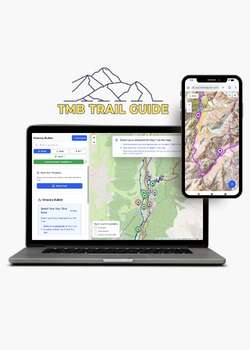
The only Tour du Mont Blanc planning tool & guidebook built for specifically for campers.
Plan your route, compare campground options, export GPS files, and access detailed camping logistics—all in one place.
Build & customize your camping itinerary
Access curated TMB camping itineraries
Access a complete digital guidebook for camping on the TMB
Designed around real TMB camping logistics and route planning challenges.


Stage 4: Val Veny to Courmayeur
Standard Camping Option: There are no campgrounds in Courmayeur itself. Campers will need to use public transportation or return to nearby campgrounds in either Val Veny or Val Ferret.
On Stage 4, campers will need to make their way back to the main TMB trail and continue to Courmayeur. The easiest way to do this that also avoids skipping any sections of the trail is to simply retrace your steps from the end of the previous stage and make your way (either via walking or via bus) back to the main TMB at the junction near Lac Combal.
From this point you will begin the steep hike up to the Mont Favre spur, which has some of the best views of the entire TMB. The trail then follows a lovely balcony path all the way to Rifugio Maison Vieille before a steep, forested descent into Courmayeur.

Camping Logistics for Courmayeur
Because there are no campgrounds directly in Courmayeur, campers have two main options:
Option 1: Return to Val Veny
This is our preferred strategy.
We typically leave our tent set up at Camping Aiguille Noire, hike into Courmayeur with a lighter pack, and then return to the same campground for a second night.
This approach:
- avoids packing/unpacking camp repeatedly
- allows for a lighter hiking day
- simplifies logistics considerably
Option 2: Continue to Val Ferret
Alternatively, campers can take the local bus from Courmayeur toward Val Ferret and stay at one of the campgrounds there:
Need help visualizing the camping detours?
The Italian section of the TMB is where camping logistics become significantly more complicated. We’ve created a free TMB camping map that highlights campgrounds, detours, and key camping infrastructure across the route. Access it below:
FREE TMB Camping Map + List

Sign-up to get your FREE TMB Campsite Map + List. Start planning your camping adventure with this resource!
Stage 5: Courmayeur to Val Ferret
Standard Camping Option: Camping Grandes Jorasses in Val Ferret (requires a detour from the TMB)
Stage 5 requires a bit more logistical coordination for campers, but it’s still very possible to camp legally while staying close to the traditional TMB route. To begin the day, campers will first need to return to Courmayeur from their campground in either Val Veny or Val Ferret using the local bus network.
From Courmayeur, the TMB climbs steeply toward Rifugio Bertone before leveling out along one of the most spectacular balcony trails of the entire route beneath the Grandes Jorasses.
Continuing onward, Rifugio Bonatti makes an excellent lunch stop before reaching the head of the Italian Val Ferret.
After reaching Rifugio Bonatti, campers will have two primary options:
Option 1: Continue to Chalet Val Ferret/Arp Nouvaz (recommended)
Continue along the main TMB route to Chalet Val Ferret and the nearby Arp Nouvaz bus stop. From there, you can take the local bus down valley to the campgrounds.
Option 2: Descend below Rifugio Bonatti
Alternatively, hikers can take the steep connector trail immediately below Rifugio Bonatti to reach the Val Ferret road and the Bivio Rifugio Bonatti bus stop.
From there, it’s an easy bus ride or long-ish walk to the campgrounds.
The TMB Camping Planner makes it easy to compare these alternate camping detours and transportation options directly on the interactive map.
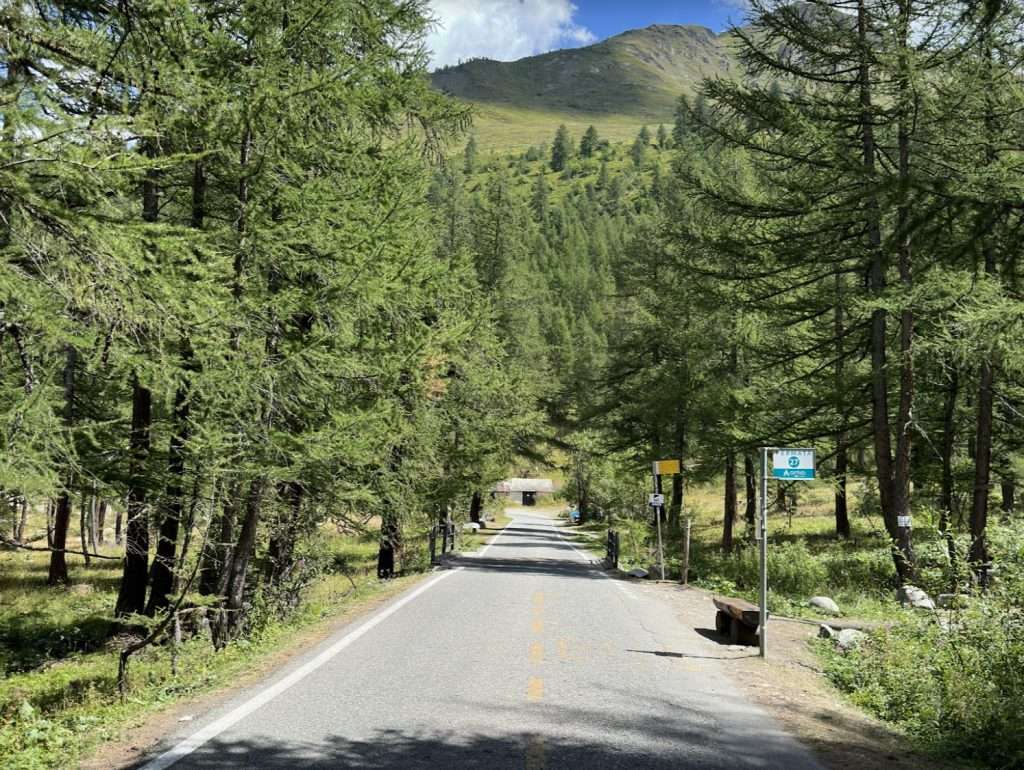
Val Ferret Campground Options
We much prefer Camping Grandes Jorasses, but both options will work.
Stage 6: Val Ferret to La Fouly
Standard Camping Option: Camping des Glaciers
Update for 2026 (30 March 2026):
Camping des Glaciers will only be able to partially open in 2026 due to a restriction put in place by the Canton of Valais due to hydrological hazards. As such, there will be much less room available for campers at this popular site.
They are recommending that all campers, including TMB hikers, make an advance booking if possible. They have stated that they pitches available for TMB campers, but we’re not yet sure if they will turn anyone away. As such, we recommend making a booking if you can.
We’ll update this section if/when more information becomes available.
The Tour du Mont Blanc leaves Italy on Stage 6, also leaving behind the many detours required to reach campgrounds on the past few stages.
Upon waking at your campground in Val Ferret on the morning of Stage 6, catch the local bus back to the head of the Italian Val Ferret and the Arp Nouvaz stop, or hike back up the connector trail to Rifugio Bonatti.
Next, you’ll simply pick up the main TMB trail where you left it on the previous stage and begin the long hike to the Grand Col Ferret and the border between Italy and Switzerland.
The views from the Col are stunning, with many distant Swiss peaks on display. From here, the trail descends into the Swiss Val Ferret passing the Alpage de la Peule before making a final approach to the village of La Fouly.
Across the river from the village center campers will find the large Camping des Glaciers campground which has excellent amenities and plenty of space to accommodate TMB campers.
Stage 7: La Fouly to Champex
Standard Camping Option: Camping les Rocailles
The so-called “easiest” stage of the Tour du Mont Blanc occurs on Stage 7 between the Swiss villages of La Fouly and Champex. Not only is the trail itself easier (although we certainly wouldn’t call it easy!) but camping logistics are also straightforward on this stage.
Most of Stage 7 is spent in a lovely pastoral Swiss valley with quaint chalets and colorful flower boxes. The final section into Champex has a steep climb, so be prepared for a bit of uphill hiking at the end of the day.
Upon arriving in Champex most campers will opt to stay at Camping les Rocailles on the far edge of town. It’s relatively expensive as far as campgrounds go (you are in Switzerland after all), but enjoys a nice location and has good facilities.
The other option to consider is located about 30 minutes past Champex:
- Relais d’Arpette: This makes the most sense for TMB hikers who are planning to hike the challenging Fenêtre d’Arpette variant route on the following day.


Stage 8: Champex to Trient
Standard Camping Option: Le Peuty Camping or Hotel du Col de la Forclaz (Camping de L’Arpille)
Stage 8 offers up multiple camping options for TMB hikers, as well as more pleasant Swiss scenery.
Regardless of whether you choose to follow the traditional Alp Bovine route or the more difficult Fenêtre d’Arpette variant, you’ll have two camping options at the end of the day: the campground behind the Hôtel du Col de la Forclaz or the basic campground near Refuge Le Peuty, just up the road from Trient.
We almost always pitch our tent at Le Peuty, preferring the simplicity of this camping area. Here you’ll find just few portable toilets and a covered eating area. Great food can be purchased at the nearby refuge, and the views are fantastic.
If you’re looking to stop a bit earlier in the day and/or find a few more creature comforts, consider camping at:
- Hôtel du Col de la Forclaz: Camping is possible in the field next to the hotel. Campers have access to hot showers, meals, and nice facilities including a sheltered space to cook and hang out.


Stage 9: Trient to Tré le Champ (and onwards to Argentiere)
Standard Camping Option: Camping du Glacier D’Argentiere (requires a detour from the TMB) or Auberge la Boerne
Stage 9 of the Tour du Mont Blanc crosses over the Col de Balme, returning to France for the first since Stage 3. The views from the Col are simply spectacular with Mont Blanc dominating the horizon above the Chamonix valley.
Camping on this stage presents two main options:
- Take ~3 km detour from the main TMB to the town of Argentiere, where there is a large and well-run campground. Upon reaching Tré le Champ, take a path leading down to the main valley and Argentiere. From here, you’ll have a 20 minute walk through the town to reach Camping du Glacier D’Argentiere.
- Just off the main trail in Tre-le-Champ you’ll find Auberge la Boërne, which camping is permitted adjacent to the gite. Note that to camp here you must purchase half-board (dinner and breakfast) at the refuge and they have a limited amount of space to accommodate tents. We recommend reaching to them in advance to confirm your intentions to camp there.
Finally, an alternative option for this stage is to camp at Gîte d’Alpage Les Ecuries de Charamillon. The Gite is located on the Le Tour alternate route which takes a more direct descent from the Col de Balme down ski slopes to the village of Le Tour. The Gite is located approximately halfway down the descent.
Planning a camping itinerary on the TMB quickly becomes more complicated than simply following the standard route. Campground detours, transportation shortcuts, and alternate stage options can dramatically change your itinerary from day to day.
That’s exactly why we built the TMB Camping Planner & Guide.
The only Tour du Mont Blanc planning tool & guidebook built for specifically for campers.
Plan your route, compare campground options, export GPS files, and access detailed camping logistics—all in one place.
Build & customize your camping itinerary
Access curated TMB camping itineraries
Access a complete digital guidebook for camping on the TMB
Designed around real TMB camping logistics and route planning challenges.
Stage 10: Trient to La Flégère
Standard Camping Option: Bivouac adjacent to Refuge de la Flégère.
Upon leaving Tré le Champ, the Tour du Mont Blanc climbs high above the Chamonix valley where it follows the spectacular Grand Balcon Sud trail. Most TMB hikers opt to stay at either Refuge de la Flégère or Refuge Lac Blanc on this stage, and luckily there are camping options available near both refuges.
First, campers can pitch their tent next to the small lake adjacent to Refuge de la Flégère from sunset to sunrise. It’s possible to access services inside the cable car station during opening hours, and you can also purchase meals at the refuge (reserve in advance).
Higher up the trail, bivouacking is permitted at:
- Lacs des Chéserys: This is a scenic wild camping area that can be reached via the Lac Blanc variant. It’s important to note that you must make a reservation prior to bivouacking at Lacs des Chéserys. This is a new requirement that is intended to limit the total number of tents and environmental impact in the area.
Should you prefer a campground with more amenities and services you can also take the Flégère or Planpraz cable cars down into Chamonix where you’ll find plenty of additional camping options.

Stage 11: La Flégère to Les Houches
The final stage of the Tour du Mont Blanc!
You have nearly completed the entire route at this point and all that stands in your way is the final stage from La Flégère back down into Les Houches. If opted to camp in the valley instead of bivouacking at La Flégère or Lacs des Chéserys, simply take the cable car back up to rejoin the trail and continue onwards from there.
For those looking to split this stage into two, there is the possibility to bivouac near the Refuge de Bellachat, where two possibilities exist:
- Refuge de Bellachat allows bivouacking at 10 tent sites adjacent to the refuge. You must check-in and pay at the refuge prior to pitching your tent.
- Bivouac/wild camping by permit is possible above the refuge in a specifically designated zone. Permits must be obtained online, in advance for bivouacking in this zone and can be reserved here.
Highlights of the Tour du Mont Blanc’s last stage include amazing views of Mont Blanc and the Col du Brévent (and option to summit Le Brévent), all capped off with a final knee crushing descent back into Les Houches.
Upon finishing in Les Houches, you can camp at Camping Bellevue in Les Houches or head towards Chamonix and one of the many campgrounds in that area. However, we always recommend splurging on a hotel after 10 nights of camping!
Do I Need Reservations?
Campers on the Tour du Mont Blanc do not need to make advance bookings at any campgrounds along the route. You can expect that many of the campgrounds will be quite full during peak season, but they always make room for TMB hikers.
Tour du Mont Blanc Campground List
In addition to the stage-by-stage TMB camping itinerary above, you can check out the full list of campgrounds along the Tour du Mont Blanc below.
FREE TMB Camping Map + List
Sign-up to get your FREE TMB Campsite Map + List. Start planning your camping adventure with this resource!
| Campground | Location | On Main TMB Route? |
|---|---|---|
| Camping Bellevue | Les Houches | Yes |
| Refuge de Miage bivouac | Next to Refuge de Miage | No, located on the Col de Tricot variant |
| Camping le Pontet | Les Contamines | Yes |
| Refuge Nant Borrant bivouac | Next to Refuge Nant Borrant | Yes |
| Refuge de la Balme bivouac | Next to Refuge de la Balme | Yes |
| Refuge de la Croix du Bonhomme bivouac | Next to Refuge de la Croix du Bonhomme | Yes |
| Les Chapieux campground | Les Chapieux | Yes |
| Hobo Camping | Val Veny | No, located in Val Veny |
| Camping Aiguille Noire | Val Veny | No, located in Val Veny |
| Camping Monte Bianco la Sorgente | Val Veny | No, located in Val Veny |
| Camping Grandes Jorasses | Italian Val Ferret | No, located in Val Ferret |
| Camping Tronchey | Italian Val Ferret | No, located in Val Ferret |
| Camping des Glaciers | La Fouly | Yes |
| Camping Les Rocailles | Champex | Yes |
| Relais d’Arpette | Champex/Arpette | No, located on the Fenetre d’Arpette variant |
| Hotel Col de la Forclaz Campground / Campsite L’Arpille | Col de la Forclaz | Yes |
| Le Peuty Campground | Trient/Le Peuty | Yes |
| Auberge la Boerne | Tre-le-Champ | Yes |
| Camping du Glacier D’Argentiere | Argentiere | No |
| Gîte d’Alpage Les Ecuries de Charamillon | Between Col de Balme & Le Tour | No, on the Le Tour variant route |
| Lacs des Chéserys bivouac | Lacs des Chéserys | No, on the Lac Blanc variant route |
| Refuge de la Flégère bivouac | Adjacent to Refuge de la Flégère | Yes |
| Refuge de Bellachat Bivouac | Adjacent to Refuge de Bellachat | Yes |
Wild Camping on the Tour du Mont Blanc
Wild camping on the Tour du Mont Blanc is a complicated subject. There are different rules for each of the counties along the route. The Autour du Mont Blanc website has a good summary.
Our advice?
We recommend sticking to the designated and approved wild camping locations along the TMB. You’ll find plenty of campers willing to share their secret (read: illegal) wild camping spots in Facebook groups, but these are illegal wild camps for a reason. Please respect the trail and the local communities and only camp in legal areas.
Summary & What’s Next?
Camping on the TMB is a wonderful way to experience the trail. You’ll sleep under the stars in some amazing locations and avoid the headaches that can come with the refuge booking process.
Pitching your tent gives you flexibility to change plans based on the weather, your fitness, and trail conditions – it is our favorite way to experience the trail and we highly recommend you consider tenting on the TMB!
Tour du Mont Blanc Camping: Key Takeaways
You can camp every night on the Tour du Mont Blanc.
Detours off the main route are needed to reach official campgrounds, especially in Italy.
Stick to designated wild camping and bivouac areas.
As you continue to plan your Tour du Mont Blanc adventure, we recommend checking out the additional resources and guides below to help plan a smooth trek:
Tour du Mont Blanc Gear List
Whether you are camping, staying in refuges, or a combination both we have you covered with our comprehensive gear list.
Tour du Mont Blanc Refuge Guide
Not sure if camping is for you?
Check out our detailed guide to the refuges along the TMB to see if you’d rather sleep indoors.
Stages of the Tour du Mont Blanc
Get a sense of what to expect on the trail with our detailed stage-by-stage description of the Tour du Mont Blanc.

By far that’s the best TMB camping guide I read so far, thanks a lot! 🙂
Thanks Gianluca! We’re so glad you found it helpful!
Hi.
This is a great post, thanks a lot.
We plan the TMT with our tent this year first 2 weeks in September, and even though we know it’s a bit a personal thing, what do you think about our sleeping bags?
We have a comfort -1°C / limit -7 °C and a comfort 11°C / limit 7°C. Maybe September is already a bit cold for the 2nd option as we will be sleeping at around 1500m altitude all the time?
Thanks for your advice on this matter!
Hi Yannick!
Thanks for your comment. We’d recommend the -1°C sleeping bag for September. Unless the weather is really harsh, you’d likely be okay with some extra layers and the 11°C bag, but you will be more comfortable with the warmer option. Have a great trek!
Hello! The camping guide is fantastic 🙂 I plan to camp with one friend late August/early September. Do you have recommendations about where to stay for a night before getting on the trail? We are hoping to leave some luggage at a hotel while we’re on the trail. Any thoughts on the pros and cons of Charmonix versus Les Houches? Or any hotels you would recommend for TMB backpackers? We plan to fly in, spend the night somewhere, and get on the trail the following day.
Hey Josie – glad you are finding the guide helpful! There are lots of great options in both Chamonix and Les Houches. For Chamonix we like Hotel Le Morgane, Hotel Plan B (right by the bus station), and Heliopic Hotel Chamonix. They should all save some luggage for you if you stay there before and after. We usually stay in Les Houches the night before as we prefer the quieter village vibe compared to the hustle and bustle of Chamonix. But Chamonix is more convenient for getting food and any supplies you might need.
Hope that helps!
So helpful thanks, would be great if you included the mileage between each stage/campsite. Do you know if it’s necessary to book accommodation in Courmayeur in advance, and if so how far in advance? Since it’s a bigger town is there more availability? Seems like a good spot to take a half or full rest day.
Thanks!!
Hi Jay,
Sorry for the delayed response! Yes, we’d recommend booking your Courmayeur accommodation in advance. It’s our favorite place for a rest day and we’d encourage you to enjoy some extra time there if you are able to fit it into your itinerary.
Ian, great job on the TMB guide; it is the best out there. I plan to hike the TMB with my wife, a non hike, mid to late July. What stages could she skip and meet me at the end of the sage? Thanks.
Hi Hernan,
Thanks for reaching out and we’re glad you’re finding the guide helpful! You can camp a couple of nights in the same place in the Italian section of the trail, making it easy for your wife to skip these sections. Additionally, it’s fairly easy to use public transit to skip the section from La Fouly to Champex. Finally, it’s easy to skip the stages between Tre-le-Champ and Les Houches (or she can utilize cable cars to reduce the distance/challenge of those days). Let us know if you have additional questions.
I feel appreciated having this webpage.
It share with valuable information for all hiker who plan to Tour du Mont Blanc. Thank you so much.
Thanks, James! Glad you are enjoying our site!